

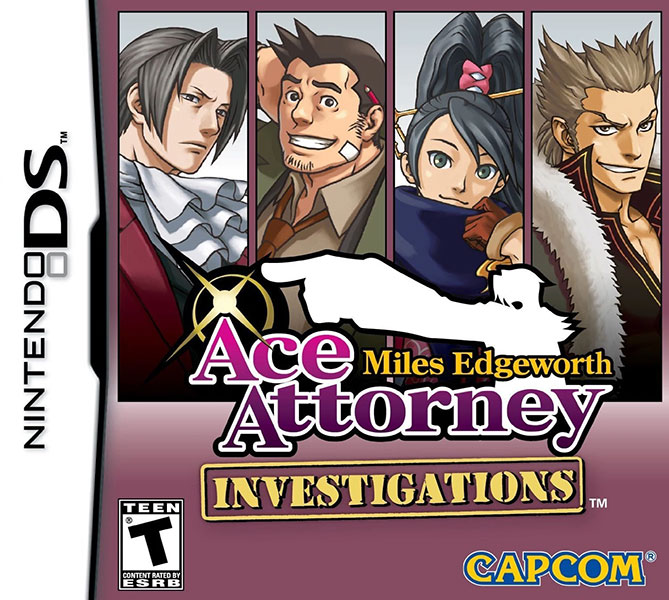
Ace Attorney Investigations: Miles Edgeworth
Why have I hesitated to write about Ace Attorney Investigations: Miles Edgeworth for so long? Why out of all the Ace Attorney games was this one starring Phoenix Wright’s most recognisable rival proving to be a challenge after the thousands of words I already wrote when reviewing the core series? The reason is because while this starts off as a fun detective game, it soon becomes an overlong bore that refuses to end, and the thought of reliving that experience was so painful, it’s taken six years and a snoozy December time slot for me to finally do it!
This spin-off isn’t all terrible, though. It’s closer to being a traditional point and click adventure, with its 2D characters exploring pre-rendered environments for clues and conversations that will lead our lovable prosecutor to the truth and justice he so desperately craves. The sprite work isn’t in the same league as Ace Attorney’s beautiful graphics, and by using the same game engine, players will find some annoyingly familiar problems. Like not being informed when a new topic of conversation opens, or the excessive amount of screen flashing which can’t be turned off in the original Nintendo DS version. (Side note: Capcom revamped this game and its previously Japan-only sequel and released them as a collection for modern platforms in 2024. I haven’t played that version and can’t comment on it specifically…for now.)
The visual design is fairly sharp, and the side-by-side conversations make it much clearer which character is talking during any given scene. The music also has a different feel to it. It’s jarring to hear classic Ace Attorney tunes like Suspense playing when the rest of the soundtrack sounds so new, but it’s still good as always.
The gameplay elements arguably feel more substantial than your typical Ace Attorney outing, with slightly less reading per activity. However, the new movement system switching between the directional pad and touch screen isn’t ideal. The annoying penalty system returns as well, but the “HP” bar is large and refills are present, so incorrect deductions don’t lead to quite as much tedium as usual.
Elsewhere, a virtual crime scene is a clever idea, the more frequent chapter breaks are welcome, and the difficulty level isn’t bad, especially since Edgeworth himself offers players so many useful hints via his inner monologue. It’s a breezy experience for a while there, and it’s nice how each case is connected via a common thread, with some mysteries in earlier cases remaining unsolved until later.
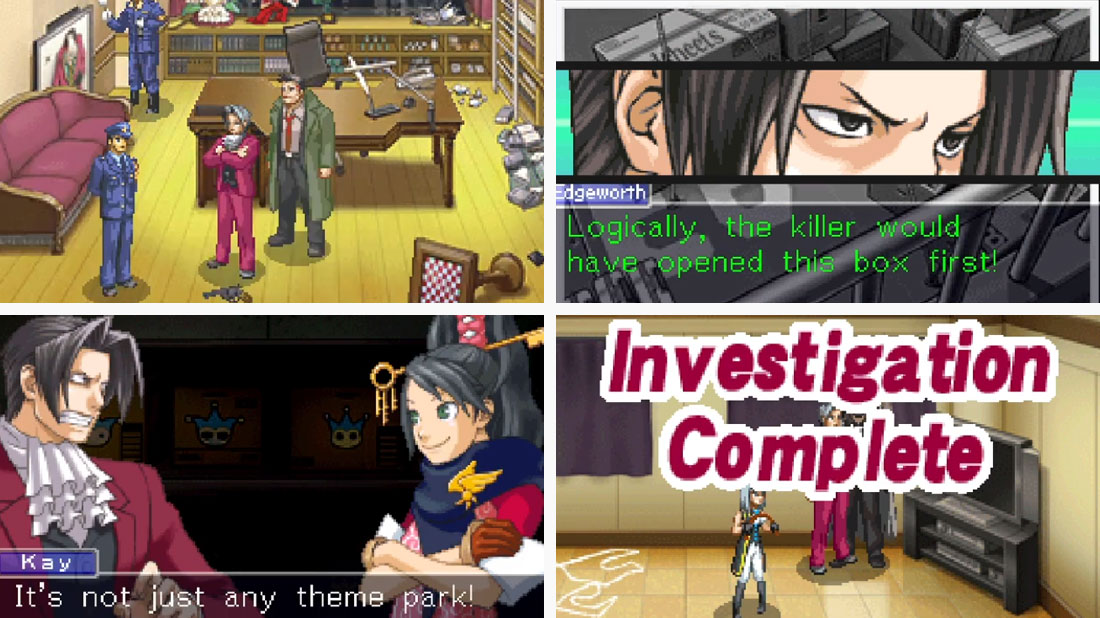
Kay makes a worthy sidekick for Edgeworth. Her grounded way of teasing is pretty fun.
The writing in Ace Attorney Investigations: Miles Edgeworth doesn’t quite sparkle like it does in other games, but the moments of character help make up for that. Miles is an able protagonist and feels delightfully human in this story — he often says sorry and offers sympathy towards other characters, and the occasional warmth he spares for his posse does allow for some nice interactions.
The man has lost none of his tenacity either. The courtroom drama which is such a prevalent part of the Ace Attorney series is remixed here into Poirot-esque confrontations where Edgeworth dismantles the arguments of his suspects. These 1v1 scenes are essentially verbal duels where the background noise falls away. The side-by-side presentation works really well here, and it’s cool how Edgeworth’s sidekicks also take part in them. Who thought that teaming him up with a random flight attendant would be such fun?
That team-up occurs during an episode set on a commercial flight. It packs a surprising amount of momentum for only the second case, with the plane presenting a novel setting for an inventive murder mystery above the clouds. The snug environments work well throughout the game, in fact, and it’s nice to see animated NPCs like policemen and custodians going about their business to help the world feel more alive.
Case 3 is where the game starts to plummet, though. The story here is poor, featuring obvious twists and a boring subplot about suspects wearing mascot costumes, and there’s an overly complex mystery involving mirrors which quickly becomes boring. This case is also when the cameos become too indulgent, as it introduces Ema Skye, Blue Badger, Wendy Oldbag, Viola, and Officer Meekins in rapid succession. It’s way too much.
The cameos are completely out of control in the fifth and final case, at which point the Ace Attorney universe has never felt smaller. One cameo barely has chance to register before another takes its place, and the constant fan service is very distracting. It’s almost as if the writers took the criticisms of Apollo Justice too seriously, and retreated into a safe and far less interesting space by relying on so many nostalgic moments and returning characters. It’s a lack of confidence which feels dreadfully atypical of Capcom’s usual flair.
Case 5 also reintroduces the theme of accusing underage children of murder. It’s a plot point that rarely sits well, but even this isn’t even the most damning thing about it. The worst thing about the final case is simply how agonisingly, soul-crushingly long it is! It takes ages for Edgeworth to finally condemn the final villain, with the narrative becoming so bogged down in technicalities and exposition, it’s just miserable to slog through. Ace Attorney is known for having overly long codas, but this one is so excruciatingly dull, it’s hard to put into words.
The awful final case is the main reason this piece took me so long to write just because of how much it soured me on the entire production. It’s so bad, it plunges Ace Attorney Investigations: Miles Edgeworth to the rock bottom of the Ace Attorney tier list, irrespective of whatever good ideas and cute moments it may have had otherwise.

Leave A Comment