

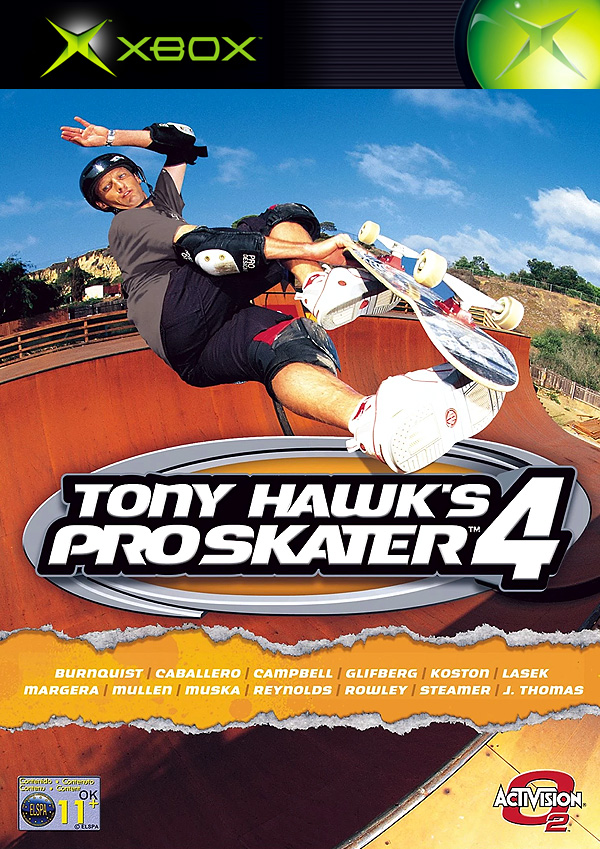
Tony Hawk’s Pro Skater 4
CelJaded is once again travelling back in time to 2002! Welcome to a time when the PlayStation 2 still ruled the world, a time when the extreme sports genre was still in vogue, and a time when Nokia product placement was still a thing. Tony Hawk’s Pro Skater 4 was coming into this year with the tough task of following a whole trilogy of universally acclaimed prequels. My Apollo Justice retrospective talked about the struggle big franchises face with their fourth game because no matter how technologically accomplished or well-designed they are by then, franchise fatigue sets in eventually, and that was certainly the case here.
Now, even though Tony Hawk’s Pro Skater 4 did experience weaker sales and a slight dip in review scores compared to Tony Hawk’s Pro Skater 3, it was by no means an unsuccessful game — it still sold millions of copies and its critical reception was largely very positive. Nevertheless, this release would prove to be a turning point, both for myself and for the wider franchise’s future.
The Neversoft of 2002 were no longer competing with themselves. The extreme sports genre had exploded since they developed the first Tony Hawk’s Pro Skater, leaving the market saturated with imitators and the competition for consumer wallets fiercer than ever. The bubble was going to burst soon, but until then Neversoft were determined to shake things up and design Tony Hawk’s Pro Skater 4 a little differently in order to stay relevant. Thus did the gameplay more tightly embrace its Grand Theft Auto leanings and shift to a semi open world format.
The two-minute timer is gone from the Career mode and the size of each map has expanded, so players can freely skate environments from college campuses to shipping yards without the pressure of their run ending prematurely. Each map is also filled with a higher number of activities and collectables, with mission goals now assigned by various NPCs the player must track down first.
Probably because of their increased size, the maps have reduced visual detail, and the character models seem slightly blockier to compensate for this as well. However, thanks to some rather deft rendering techniques, the game does run smoothly, with its native 720p output on Xbox meaning the production has aged extremely well from a visual standpoint. Even in 2026, this is a dead easy title to load up and play on a modern HD television, which is a huge plus for anyone revisiting the game today.
While it continues to have no online play, the game remains stacked on features, with the 2-player split-screen and system link multiplayer modes returning (mostly) intact, alongside the usual creation modes for skaters, parks, and soundtracks. Speaking of which, the editable 35-cut official soundtrack is much better here because the music selection is generally more varied and less abrasive-sounding. It’s certainly better suited for lengthy sessions where the music can play uninterrupted. (This was actually a nice benefit of the open world format because the music no longer gets cut off after two minutes!)
Nevertheless, there are many cheesy and annoying NPC voices, not to mention the persistent sound of them clapping whenever you clear an objective (that sound always weirdly comes to mind whenever I think about this game). NPCs often interrupt your flow because whenever you finish a goal for them, there is this irritating pause where players need to manually navigate menus to save their progress. Restarting objectives is very quick and easy, which is good because players will be doing so often, but more on that later.
Successfully clearing goals or finding green banknotes scattered about the self-contained maps rewards cash to spend in the shop. Players can buy new creation parts for their custom skaters, extra maps complete with new challenges, or secret skaters depending on what version of the game you own. The Xbox version includes Jango Fett from Star Wars II: Attack of the Clones (talk about franchise fatigue!), Daisy the “hot girl” (sigh), and a skating gorilla who presumably escaped from the animal-packed Zoo level to realise its dreams of being a skateboarder. So heartwarming!
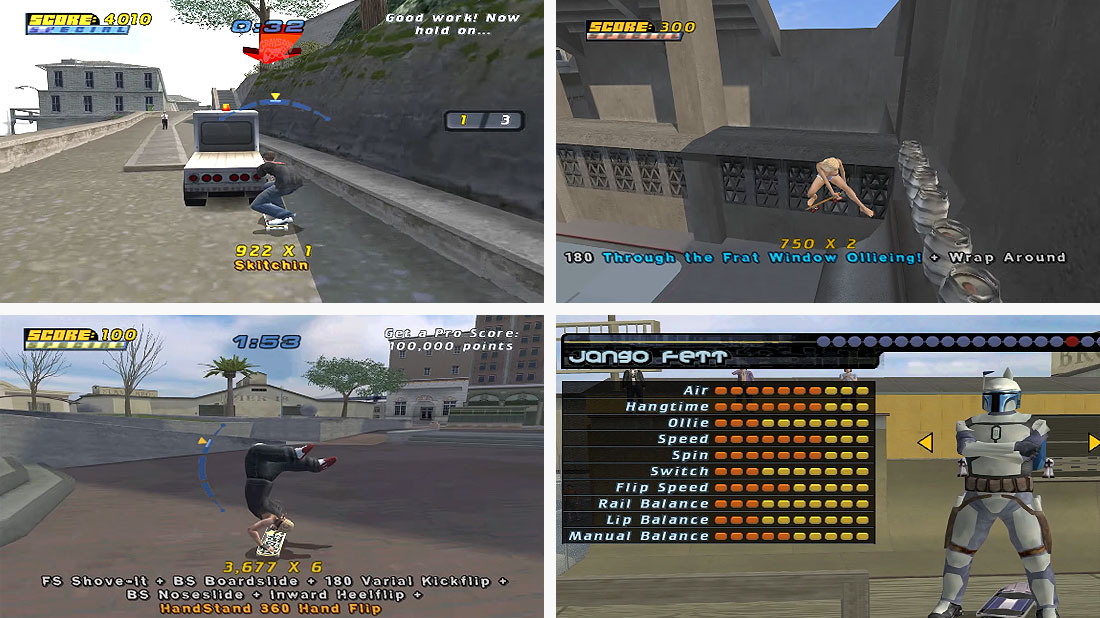
Jango’s jetpack jump is useful for reaching items which hover just out of reach.
When it comes to the skating itself, only minor things have changed from the third entry. Tony Hawk’s Pro Skater 4 introduces the spine transfer and level out techniques, as well as the ability to skitch cars and perform standing manuals. Some of these techniques can be useful if players remember to do them, but it’s sometimes difficult in the Career mode because the focus tends to be on zany challenges over the traditional score attack elements these new techniques enhance.
And it’s here where we finally come to the crux of what makes this sequel less successful for me. The structure of Career mode was changed to a consolidated campaign where players can choose any skater without the need to repeat goals across separate career paths. This does make the game less prescriptive and less repetitive, but to compensate for how drastically shorter this design is, the overall level of difficulty was increased to make players spend more time completing each map. Even early goals in the starting College are sometimes annoyingly tricky, so the difficulty curve is certainly harsher compared to the smooth progression seen in earlier titles.
Several maps have roaming vehicles to make the world feel more alive, although this also means players get bashed into more, especially during goals where a train, for example, might currently be in the way of an intended route, thus forcing players to immediately restart to create a winnable mission state. Persistent players who clear enough goals are offered the chance to undertake “pro challenges” which are extremely hard compared to their basic counterparts. There is a sense of Neversoft trying to outdo themselves here and provide their maturer player base with steeper challenges, but such difficulty does make things more tedious, too. And it doesn’t help there being no particularly satisfying end point outside of 100% completion — a feat that will be beyond many players’ capabilities.
When you consider this was done to accommodate the removal of the timer, it suggests the open world design actually suppresses what makes the skating experience so urgent and alive compared to these huge checklists of frustrating goals in maps arguably too big for their own good. Players can always choose to skate in Single Session if they want the timer back, but the Career mode represents such an enormous amount of content, the criticism isn’t easy to ignore.
Moving to an open world format also may have worked better if players could get off the skateboard to more easily move around tight spaces and platforms featuring collectables and such. Alas, players are still anchored to their boards, so the design is caught in this awkward middle ground where skaters are perpetually moving forwards. It doesn’t entirely work.
Tony Hawk’s Pro Skater 4 isn’t a bad game. It’s still built on a good formula with a high level of customisation and quality to make it worth playing. But there’s no escaping how it felt like a sideways step for the franchise, to the point where it rather sadly ended up being the last Tony Hawk’s game I ever played.
Ultimately, this was a title caught in a transitional divide where its parent franchise was due a major paradigm shift. For the curious gamers who have never played it before, the quality of its presentation makes the game easy to revisit today, even if it did herald the end of the traditional Tony Hawk’s games as we knew them.

Leave A Comment